Political corruption is a term that broadly refers to acts by elected officials that benefit themselves at the expense of the country or their constituents. The Supreme Court has recently taken a much narrower view of the legal definition as only including acts using the official powers of public office or of attempting to influence others to use their official powers for personal gain. Political corruption can include bribery, extortion, cronyism, nepotism, parochialism, patronage, influence peddling, and graft. Corruption may facilitate other crimes such as money laundering, fraud or embezzlement or it may be subtler. More subtle forms of corruption may involve changing regulations to benefit a campaign donor or providing access to decision makers in exchange for patronizing a business owned by someone related to a politician.
Read More
What you can doFor anyone interested in participating in our Op-Ed Project (Building a Better Society Through Science), we will be holding a webinar on November 9 at 1 pm EST/10 am PST. See details here.The FCC has extended the period for public comments on the proposed takeover of Tribune Media by the controversial Sinclair Broadcast Group. Comments can be submitted here (see more instructions here). Comments must be submitted by November 2.Senate passes budget resolutionOn Thursday, October 19, the Senate narrowly passed its budget resolution. The House passed its own version earlier in October, and will now consider the changes in the Senate's version. In principle, the budget resolution serves as the first part of Congress' budget process, setting the spending limits for the appropriations bills that lay out the federal budget in more detail. However, because it is happening so late in the process, this year's budget resolution is seen as not being about the actual federal budge...
Read More
Executive privilege is a kind of legal immunity enjoyed by the sitting President of the United States. This privilege allows the president (and only the president) to withhold information from Congress and the public. While not written in the Constitution, this privilege is derived from an interpretation of the constitutional separation of powers doctrine and the supremacy of each branch of government over the other in their own sphere. Presidents have claimed executive privilege to ensure executive branch officials can speak confidentially and candidly regarding their responsibilities in office. However, the Supreme Court's decision in United States v. Nixon found that the president's ability to invoke the privilege is "qualified" (as opposed to absolute), meaning that it must be justified and is subject to limitation. Usually, the privilege protects only that information that protects military, diplomatic or sensitive national security secrets. Those who assert executive privil...
Read More
What you can doThe Department of Homeland Security (DHS) has proposed new rules to monitor the social media of all immigrants to the United States. To oppose this rule, submit a public comment here. Comments must be received on or before this Wednesday, October 18, when the new rules go into effect.Trump's NOAA and CEQ nominees draw pushback from senators, former officialsOn October 12, President Trump nominated AccuWeather CEO Barry Myers to lead the National Oceanic and Atmospheric Administration (NOAA). If confirmed by the Senate, Myers would be the first NOAA administrator since 1981 to hold no science degrees. AccuWeather, which relies heavily on National Weather Service (NWS) data, has previously lobbied for restrictions on public distribution of NWS weather data to increase profits for private companies using these data, and Myers supported then-Senator Rick Santorum's (R-PA) 2005 efforts to partially privatize NWS services. Senators Brian Schatz (D-HI) and Bill Nelson (D-FL)...
Read More
The word "emoluments" is construed broadly to mean any kind of benefit, profit or advantage. The Foreign Emoluments Clause (Article 1, Section 9, Clause 8) prohibits any officer of the United States from accepting gifts from foreign states without the consent of Congress. The Domestic Emoluments Clause (Article 2, Section 1, Clause 7) prohibits a President from receiving additional emoluments of any kind from the United States or individual states, other than his or her compensation. Its original intent was to avert Congressional legislators and state elected officials from seeking favor by bribing the President. The threat of corruption was of deep concern to the Framers of the Constitution. The Framers understood that a President could abuse his or her powers for financial gain at the expense of national interests. In an attempt to curtail this threat, the Framers adopted the Emoluments Clauses which prohibits federal officials from accepting items of value from foreign or s...
Read More
What you can doThe Department of Homeland Security (DHS) has proposed new rules to monitor the social media of all immigrants to the United States. To oppose this rule, submit a public comment here. Comments must be received on or before October 18, when the new rules go into effect.RISE Stronger is presenting a webinar on "Building Coalitions that Last", from 7 to 8:30 pm EDT on Thursday, October 12. Register and learn more here.House passes FY18 budget resolutionOn October 5, the House narrowly passed a budget resolution that would increase defense spending by $72 billion and reduce non-defense spending by $5 billion. The budget includes cuts to education, healthcare, and nutritional assistance, and also contains reconciliation rules that would protect an upcoming tax-reform bill from filibuster. House Democrats—joined by 18 Republicans—voted as a bloc against the resolution and warned that the planned tax cuts would benefit only the wealthiest Americans. The Senate's version of t...
Read More
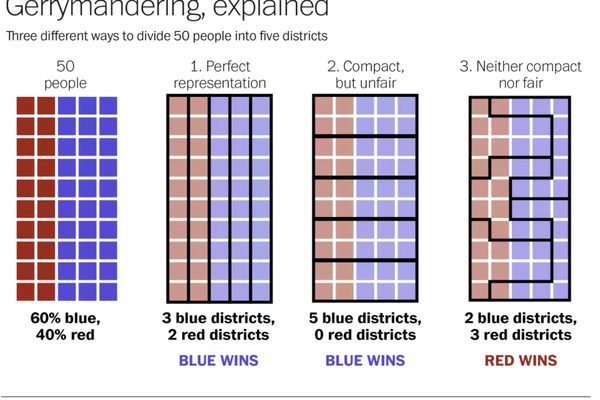
washingtonpost.com/wonkblog - Adapted from Stephen Nass
Gerrymandering is the practice of dividing a state or county into electoral districts so as to give one political party a majority in many districts while concentrating the voting strength of the other party into as few districts as possible. The practice has been part of American politics since before our Constitution went into effect, but the term was coined in 1812 as a result of Massachusetts governor Elbridge Gerry's redistricting of the state. A newly drawn electoral district map reminded some observers of a salamander, and so the term "Gerry-mander" was born. In general, partisan gerrymandering is not illegal, but should it be? One of the most significant cases that the Supreme Court will decide this term, Gill v. Whitford, raises the issue of whether partisan gerrymandering can so distort citizens' voting power that it violates our right to "equal protection of the laws" pursuant to the Fourteenth Amendment of the Constitution. The plaintiffs in Gill are Wisconsin voters wh...
Read More
What you can doFind out how you can support hurricane relief for Puerto Rico here.Find out how you can help victims of the mass shooting in Las Vegas here.The Department of Homeland Security (DHS) has proposed new rules to monitor the social media of all immigrants to the U.S. To oppose this rule, submit a public comment here. Comments must be received on or before October 18, when the new rules go into effect.
FCC Chairman confirmed; legislators, tech community object On October 2, acting Federal Communications Commission (FCC) Chairman Ajit Pai was confirmed by the Senate, in a 52-41 vote, for a four-year term. The confirmation was expected, given Republican support for Pai; four Democratic Senators (Claire McCaskill, D-MO; Gary Peters, D-MI; Joe Manchin, D-WV; and Jon Tester, D-MT) also voted for confirmation. However, other Senate Democrats strongly opposed the confirmation. Sen. Maria Cantwell (D-WA) issued a scathing press release condemning Pai's efforts to roll back net n...
Read More
What you can do:Call your member of Congress and ask him or her to ensure Superfund enforcement is funded.Submit written comments to FERC asking the agency to reject the Department of Energy's proposed rule.DOE proposes additional compensation for coal, nuclear Plants. The Department of Energy (DOE) sent a proposed rule to the Federal Energy Regulatory Commission (FERC), the independent agency charged with oversight of the nation's wholesale electricity markets. DOE's proposal and an accompanying letter from Energy Secretary Rick Perry cite the many recent retirements of coal and nuclear plants as a problem for the resiliency of the nation's electric grid. To prevent further retirements, DOE asked FERC to require that wholesale electricity markets provide additional compensation to coal and nuclear plants to compensate them for "reliability, resiliency, and on-site fuel assurance." DOE's proposal drew swift criticism from industry participants for favoring one fuel source over anoth...
Read More
Puerto Rico is a commonwealth of the United States. However, in practice, Puerto Rico technically is not a commonwealth. A commonwealth is defined as a nation, state or other political unit where "supreme authority is vested in the people." (Source) While Puerto Rico has its own constitution, judiciary, legislature and governor, in a recent decision the Supreme Court determined that the ultimate source of sovereignty over Puerto Rico is the U.S. Congress (Source). People born in Puerto Rico are U.S. citizens, they pay into Social Security and Medicare, but they cannot vote for President and cannot vote on legislation in the U.S. Congress. Although Puerto Rico is a "commonwealth" on paper, the practical realities are far more complicated. (Source)