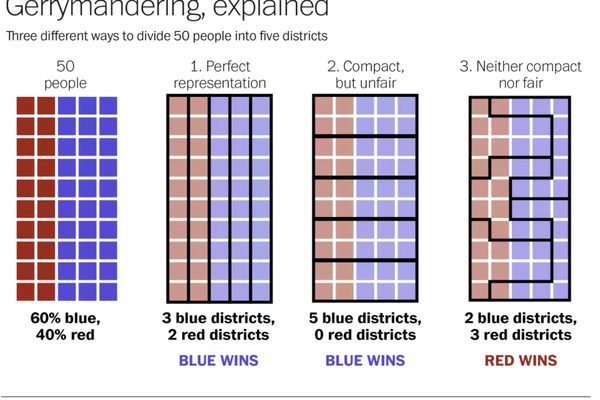
Gerrymandering is the practice of dividing a state or county into electoral districts so as to give one political party a majority in many districts while concentrating the voting strength of the other party into as few districts as possible. The practice has been part of American politics since before our Constitution went into effect, but the term was coined in 1812 as a result of Massachusetts governor Elbridge Gerry's redistricting of the state. A newly drawn electoral district map reminded some observers of a salamander, and so the term "Gerry-mander" was born.
In general, partisan gerrymandering is not illegal, but should it be? One of the most significant cases that the Supreme Court will decide this term, Gill v. Whitford, raises the issue of whether partisan gerrymandering can so distort citizens' voting power that it violates our right to "equal protection of the laws" pursuant to the Fourteenth Amendment of the Constitution. The plaintiffs in Gill are Wisconsin voters who argue that the state's Republican-controlled government violated their constitutional rights by deliberately redrawing districts since 2010 in such a way as to lock Democrats out of power for the foreseeable future. The lower court sided with the plaintiffs, ruling that the Wisconsin government violated voters' rights under the First and Fourteenth Amendments. Some legal commentators argue, however, that courts should avoid striking down district maps because there is no reliable test for judges to use that would consistently distinguish between legitimate and illegitimate ways of drawing district lines. The Supreme Court's decision in Gill will affect how much your vote is worth, and how polarized our political landscape is, for many years to come.
Sources: