|
Jun 21, 2017
Weeks 20 & 21 in Infrastructure and Urban Policy Robbing from Peter to Pay Paul: Air-Traffic-Control, Army Corps of Engineers, and Housing as Infrastructure Did you know? If placed end to end, the length of the nation's structurally deficient bridges would stretch 1,276 miles or half the distance from New York to Los Angeles. (ARTBA 2017 Bridge Report) On aviation, infrastructure, and "social infrastructure," the Trump Administration continues to say one thing and do another. While Rise agrees with making the public sector more efficient, effective, and user-centric, we believe those improvements cannot come at the expense of citizen safety and well-being. Privatizing the Air-Traffic-Control System Why are we exposing travelers and air-traffic control data to harm and hacking? Two weeks ago, President Trump kicked off infrastructure week by announcing his commitment to privatizing the management of the U.S. air-traffic-control system. That system is currently managed by the Federal Aviation Administration (FAA), a government agency that oversees all aspects of commercial aviation. Trump Administration plans transfer control of the air-traffic network from the FAA to a not-for-profit private entity. If this sounds familiar, it may be because House Republican Bill Shuster introduced this concept through his Aviation Innovation, Reform, and Reauthorization Act (AIRR) which died before it reached the House floor. Based on a faulty theory of trickle down economics, Trump's plan will cost taxpayers even more than what they are paying now. As Senate Minority Leader Chuck Schumer emphasized, "privatization of public goods, whether it's for the construction of roads and bridges or in this case, aviation, often leaves the average American with the short end of the stick and gives big corporations way too much power. It could cost middle-class families even more and not create the kinds of jobs our economy needs." This is not middle-class economics. As for workers, the National Air Traffic Controllers Association (NATCA) President Paul Rinaldi made it clear that the union group will not support a for-profit model of control. Furthermore, any true not-for-profit proposal must meet the following NATCA conditions:
While Rise hopes the Trump Administration can meet these demands, there is reason for concern. The plan could not only be costly but also potentially dangerous. Opponents of the Trump plan argue that an entity guided largely by commercial interests may prioritize industry profits over safety and security. Former Secret Service Director Mark Sullivan, echoed this concern and questioned whether background checks for air traffic controllers might become less rigorous. He added that the FAA's role has included securing airspace during high-profile events such as presidential inaugurations, political conventions, other national special security events, and whenever Air Force One traverses the country. Privatization of the air traffic control could "pose a multitude of chain of command issues, differing priorities, and perspectives that could potentially elevate risk and interfere with the end goal of ensuring aviation security." In the latest development, South Dakota Senator John Thune (R), who leads the Commerce, Science and Transportation Committee, said the Senate's long-term reauthorization of the Federal Aviation Administration (FAA) will not include the spinoff plan, citing the lack of support for the idea on his panel. Latest speculation suggests the House will lead an effort to transfer control to a private corporation. We must continue to stay vigilant in preventing this from happening. We need a plan that prioritizes American safety and taxpayer cost-saving. Army Corps of Engineers Why are we jeopardizing the safety and sustainability of critical infrastructure? Despite President Trump's rhetoric about investing in the nation's infrastructure, the cuts to the Department of Transportation (DOT), Department of Housing and Urban Development (HUD), and the Federal Emergency Management Agency (FEMA) in the White House's "skinny budget" suggest a narrow, misguided focus that takes America down the wrong road.
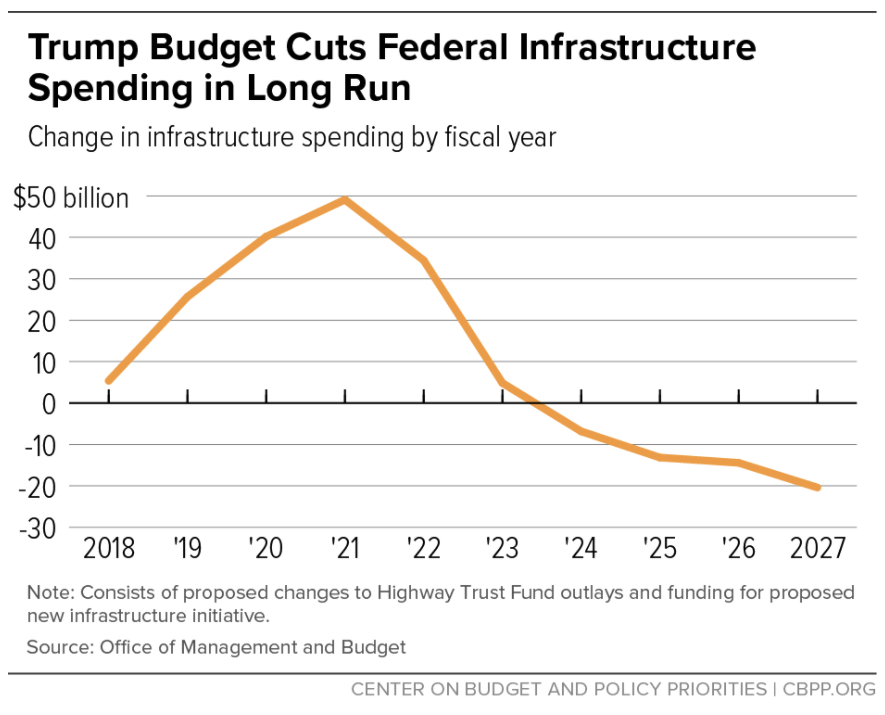
How? In recent years, the dedicated revenues for the Highway Trust Fund (mostly from the gasoline tax) were insufficient to cover ongoing "baseline" spending from year to year. While gas taxes eroded, lawmakers on both sides of the aisle transferred money year after year into the trust fund to keep infrastructure spending from falling. Trump's budget, however, proposes that beginning in 2021, the Highway Trust Fund will spend no more in a given year than the dedicated revenues it receives. What does that mean? The Administration proposes cutting Highway Trust Fund spending over time after an initial investment, resulting in significant cuts over time to balance the budget. This is in addition to disturbing cuts to Amtrak and DOT's TIGER grant program — all of which could cancel out and ultimately negate any temporary rally in the nation's infrastructure spending elsewhere.
Another Broken Promise Where is housing in the infrastructure proposal? Moreover, no one can figure out how Trump plans to achieve his $1 trillion promise. The White House's budget proposal lines up $200 billion for infrastructure over the next 10 years. The rest of the $1 trillion that candidate Trump pledged is intended to come from private investment, but it's unclear how the administration will achieve that. "We are also for using the private sector to leverage money," Marcia Hale, president of the infrastructure advocacy group Building America's Future, told The Atlantic, "but the need in the country is so great that the $200 billion number is not going to do it. Learning from Cities and States We need to take a scout and scale approach. Measure-H in California In search of a bright line amidst disappointing infrastructure week news, Rise turned its attention to cities and states meeting the call to rebuild our built environment where the federal government falls short. Los Angeles County voters recently approved a quarter-cent sales tax increase to fund anti-homelessness measures. Measure H would generate about $355 million annually for homeless programs over 10 years, backers say. The tax increase would raise the sales tax rate to 9% across most of Los Angeles County and up to 10% in a few communities. The Trump Administration should herald these efforts rather than cut the very federal programs designed to support local and state programs to address homelessness and failing infrastructure. What you can do
|
|
Jun 10, 2017
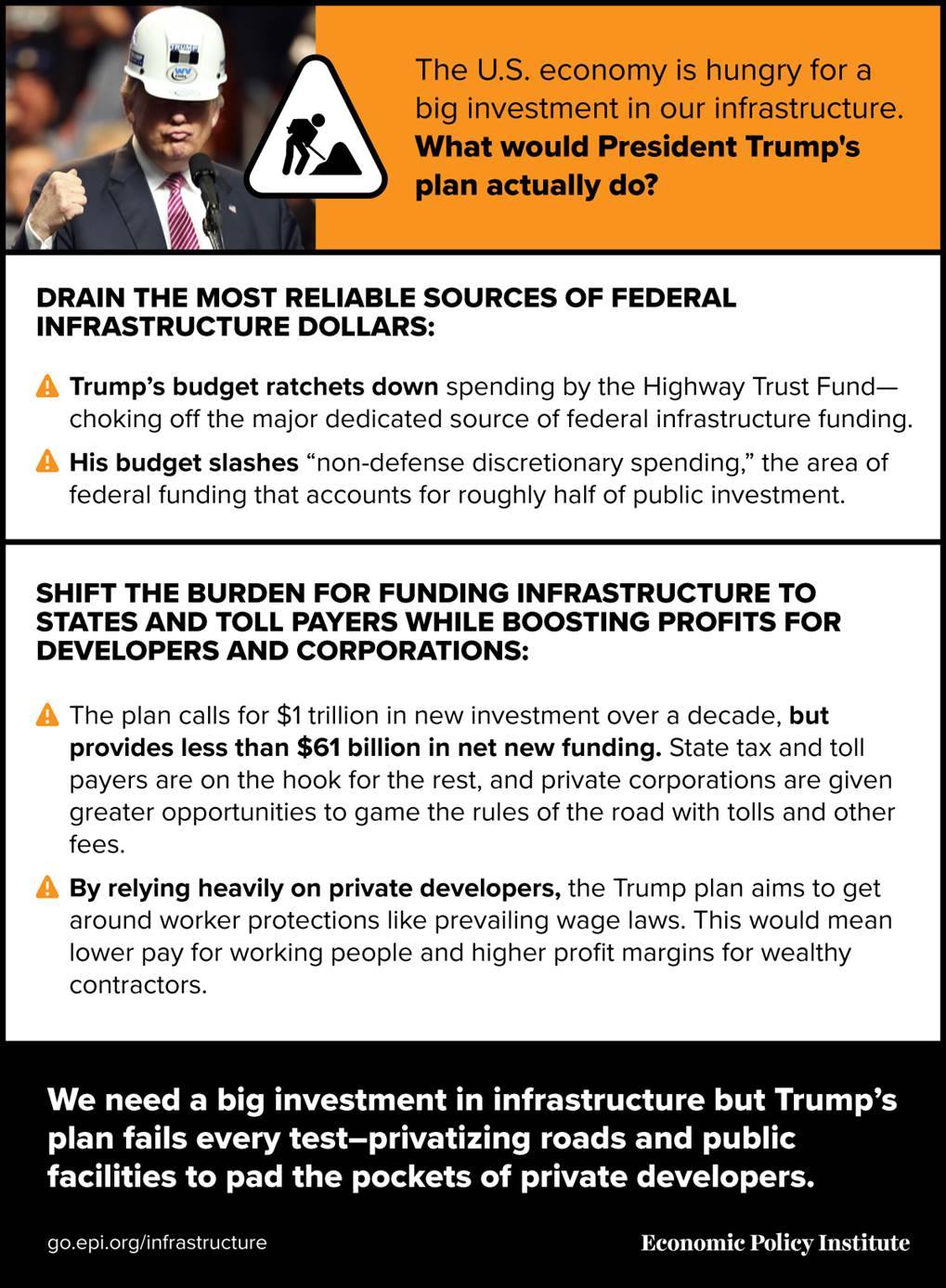
Infrastructure Week Special: An Explainer on the Infrastructure “Plan” Fact Checking the Infrastructure Proposal President Donald Trump — as part of his budget proposal — included a 2018 Infrastructure Initiative Fact Sheet. The plan is geared towards metropolitan regions and explicitly covers sparsely populated regions in the country, providing them with special treatment. Trump's Plan Claims: The flexibility to use Federal dollars to pay for essentially local infrastructure projects has created an unhealthy dynamic in which State and local governments delay projects in the hope of receiving Federal funds. The Reality: According to the EPA, 95% of water infrastructure projects are funded by state and local government entities. While the Federal government lacks capital, State and local governments who prioritize job creation of cutting taxes and offering corporate subsidies are filling the void. Trump's Plan Claims: During the construction of the Interstate System, the Federal Government played a key role – collecting and distributing Federal tax revenue to fund a project with a Federal purpose. As we neared the completion of the Interstate System, those tax receipts were redirected to projects with substantially weaker nexus to Federal interests. The Reality: The Federal Government played a significant role in the Interstate System, this is true, but to ignore the devastation caused to a number of communities as a result is irresponsible transportation planning. The completion of the highways running through urban center, had the same effect it has had in almost all cities that put interstates through their hearts. It decimated a close-knit African American community. Trump's Plan Claims: Given these challenges, the Administration's goal is to seek long-term reforms on how infrastructure projects are regulated, funded, delivered, and maintained. Providing more Federal funding, on its own, is not the solution to our infrastructure challenges. The Reality: According the Federal Highway Administration (FHWA), in 2007, every $1 billion in federal highway expenditures supported about 30,000 jobs — 10,300 in construction, 4,675 in supporting industries, and 15,094 in induced employment. While we agree that P3 investments are one useful strategy Trump's Claims: $1 trillion in infrastructure funding The reality: President Trump's "$1 trillion infrastructure plan" isn't $1 trillion and it isn't a plan. It's a $200 billion plan to have a plan that hasn't advanced beyond that stage for six months now. Trump's Claims: The infrastructure plan is a new standard for P3's The reality: The focus is not simply on using federal money as honey to attract large sums of private investment. Instead, the focus is on using federal money to leverage state and local government and also private money. (Michael Likowsky, Huffington Post) Trump's Claims: The Trump infrastructure plan will create American jobs The reality: A $1 trillion plan would be welcome because it would create 18,000 jobs for each $1 billion in investment. Instead, we have a $200 we have a promise that's not a serious plan, and won't lead to significant investments in our country's future. The Trump infrastructure plan calls for $200 billion of federal funding, "leveraging the private sector" to pay for the rest. What doe "leverage" mean? It means state taxpayers and infrastructure users will be on the hook for the other $800 billion in the form of taxes, toll roads or other privatized projects whose profits pad the pockets of private entities — not local or state budgets. EPI What can you do? Take Action Share the below image on Twitter, Facebook, and other forms of social media to spread awareness on the realities of Trump's infrastructure "plan." Tell your member of Congress that a true American infrastructure plan is mutually exclusive with gutting infrastructure funding.
|
|
Jun 10, 2017
Infrastructure Week Special: An Explainer on the Infrastructure “Plan” Fact Checking the Infrastructure Proposal President Donald Trump — as part of his budget proposal — included a 2018 Infrastructure Initiative Fact Sheet. The plan is geared towards metropolitan regions and explicitly covers sparsely populated regions in the country, providing them with special treatment. Trump's Plan Claims: The flexibility to use Federal dollars to pay for essentially local infrastructure projects has created an unhealthy dynamic in which State and local governments delay projects in the hope of receiving Federal funds. The Reality: According to the EPA, 95% of water infrastructure projects are funded by state and local government entities. While the Federal government lacks capital, State and local governments who prioritize job creation of cutting taxes and offering corporate subsidies are filling the void. Trump's Plan Claims: During the construction of the Interstate System, the Federal Government played a key role – collecting and distributing Federal tax revenue to fund a project with a Federal purpose. As we neared the completion of the Interstate System, those tax receipts were redirected to projects with substantially weaker nexus to Federal interests. The Reality: The Federal Government played a significant role in the Interstate System, this is true, but to ignore the devastation caused to a number of communities as a result is irresponsible transportation planning. The completion of the highways running through urban center, had the same effect it has had in almost all cities that put interstates through their hearts. It decimated a close-knit African American community. Trump's Plan Claims: Given these challenges, the Administration's goal is to seek long-term reforms on how infrastructure projects are regulated, funded, delivered, and maintained. Providing more Federal funding, on its own, is not the solution to our infrastructure challenges. The Reality: According the Federal Highway Administration (FHWA), in 2007, every $1 billion in federal highway expenditures supported about 30,000 jobs — 10,300 in construction, 4,675 in supporting industries, and 15,094 in induced employment. While we agree that P3 investments are one useful strategy Trump's Claims: $1 trillion in infrastructure funding The reality: President Trump's "$1 trillion infrastructure plan" isn't $1 trillion and it isn't a plan. It's a $200 billion plan to have a plan that hasn't advanced beyond that stage for six months now. Trump's Claims: The infrastructure plan is a new standard for P3's The reality: The focus is not simply on using federal money as honey to attract large sums of private investment. Instead, the focus is on using federal money to leverage state and local government and also private money. (Michael Likowsky, Huffington Post) Trump's Claims: The Trump infrastructure plan will create American jobs The reality: A $1 trillion plan would be welcome because it would create 18,000 jobs for each $1 billion in investment. Instead, we have a $200 we have a promise that's not a serious plan, and won't lead to significant investments in our country's future. The Trump infrastructure plan calls for $200 billion of federal funding, "leveraging the private sector" to pay for the rest. What doe "leverage" mean? It means state taxpayers and infrastructure users will be on the hook for the other $800 billion in the form of taxes, toll roads or other privatized projects whose profits pad the pockets of private entities — not local or state budgets. EPI What can you do? Take Action Share the below image on Twitter, Facebook, and other forms of social media to spread awareness on the realities of Trump's infrastructure "plan." Tell your member of Congress that a true American infrastructure plan is mutually exclusive with gutting infrastructure funding.
|
|
May 24, 2017
WEEK 10-16 IN INFRASTRUCTURE AND URBAN POLICY WEEKLY REPORT: INFRASTRUCTURE SPLENDA, BEN CARSON TOUR, WATER INFRASTRUCTURE, JONES ACT, AND BROKEN PROMISES MAY 16, 2017 1:01 PM EDTWhat You Can DoSign up for updates from the CarsonWatch powered by our friends at Public Advocates in collaboration with the Poverty & Race Research Action Council, the Lawyers' Committee for Civil Rights Under Law, and PolicyLink.Share your own stories about HUD's impact on your lifeSee how HUD budget cuts impact your specific communityQuestions to Ask Your Member of CongressDo you agree with Secretary Carson's stance on making life that much harder and uncomfortable for those who benefit from HUD programs?Why is there still no infrastructure bill?In an exclusive interview with the New York Times, President Trump indicated that he may attach infrastructure funding to a new health care bill, since it has bipartisan support. Specifically, the President said, "Yeah. I may put it in with something else because it's a very popular thing. We've spent $6 trillion in the Middle East, as of two months ago … uh, $6 trillion ... and yet we can't fix our own roads and our own highways. And... READ MORE |
|
May 24, 2017
WEEK 9 IN INFRASTRUCTURE & URBAN POLICY: LOCAL COMMUNITIES RESPOND TO HUD BUDGET CUTS MAR 27, 2017 4:38 PM EDTHow HUD Budget Cuts Affect Local CommunitiesAs we reported in last week's report, according to preliminary budget documents for fiscal year 2018 that were leaked, the Trump administration has considered more than $6 billion in cuts at the Department of Housing and Urban Development (HUD). We know that Trump's HUD budget cuts would disproportionately impact cities' poorest residents. Cities and counties are not taking this news lightly: CHICAGO: Eight Arrested at Downtown Protest Against Trump's Budget Cut: "Eight people were arrested on Tuesday during the eighth #ResistTrumpTuesday protest, which focused on President Donald Trump's proposed budget cuts to the Department of Housing and Urban Development. 'For us here in Illinois it means less direct rental assistance payments including section 8 housing, housing vouchers for homeless veterans would be cut by at least $300 million,' said one organizer." ChicagoistNEW ORLEANS: New Orleans Braces for Deep Cuts in Trump's Spending Plan: ... READ MORE |
|
May 24, 2017
WEEK 7 IN INFRASTRUCTURE & URBAN POLICY: HUD BUDGET CUTS, SECRETARY CARSON ON WATCH, RISE STRONGER’S INFRASTRUCTURE STANCE MAR 15, 2017 12:14 PM EDTHUD Budget CutsAccording to leaked, preliminary fiscal year 2018 budget documents, the Trump administration has considered more than $6 billion in cuts at the Department of Housing and Urban Development (HUD). Under the preliminary plan, compared to previous funding: About $1.3 billion would be cut from the public housing capital fund$600 million would be cut from the public housing operating fundDirect rental assistance payments — including Section 8 Housing and housing vouchers for homeless veterans — would be cut by at least $300 millionHousing for the elderly — known as the Section 202 program — would be cut by $42 millionThe HOME Investment Partnerships Program, which provides block grants for local communities to build affordable housing, would be cut entirelySection 811 housing for people with disabilities would be cut by $29 millionMoney available for Native American housing block grants would be cut by $150 millionChoice Neighborhoods, a program that invests in redeveloping... READ MORE |
|
May 24, 2017
WEEK 6 IN INFRASTRUCTURE & URBAN POLICY: CARSON, THE FAA, AND PLANNING BEGINS FOR THE INFRASTRUCTURE BILL MAR 8, 2017 5:43 PM ESTLast week, Ben Carson was confirmed as Secretary of the Department of Housing and Urban Development. His recent controversial comments about slavery notwithstanding, Carson is likely to roll back gains in the Affordably Furthering Fair Housing (AFFH) rule, which the new SOHUD referred to as a "social engineering" tool. AFFH requires federal grantees to further the mission of the Fair Housing Act.This week, the House Subcommittee on Aviation will hold its third in a series of hearings to prepare for a Federal Aviation Administration (FAA) reform and reauthorization bill later this year. Witnesses will include Alaska Air Group CEO Brad Tilden, SkyWest CEO Russell Childs, Air Transport Services Group CEO Joseph Hete, Association of Flight Attendants President Sara Nelson, and Travelers United Chairman Charles Leocha. Also this week, President Trump nominated Jeff Rosen to serve as Deputy Secretary of the Department of Transportation. Rosen, who has spent nearly 30 years with Kirkland &... READ MORE |
|
May 24, 2017
WEEK 5 IN INFRASTRUCTURE AND URBAN POLICY: THE INFRASTRUCTURE BILL AND FAIR HOUSING PROVISIONS FEB 28, 2017 12:16 AM ESTLast Friday, the U.S. Customs and Border Protection agency announced an upcoming solicitation for the design and construction of prototype wall structures for the border. Konstantin Kakaes, a fellow with the New America Foundation and the former Mexico City bureau chief for The Economist, estimates that the cost of building Trump's wall will be nearly $38 billion higher than current estimates.Meanwhile, H.R. 482, the Local Zoning Decisions Protection Act of 2017, is still making its way through the House after being introduced last month by Rep. Paul A. Gosar (R-AZ). The bill would nullify new Affirmatively Furthering Fair Housing (AFFH) regulations and assessment tools. It would also prohibit federal funds from being used for the HUD database system, which contains information relating to community racial disparities and disparities in access to affordable housing. In positive news, last week members of the House and Senate have moved to protect the U.S. Treasury's New Markets Tax ... READ MORE |
|
Apr 22, 2017
The group was created. |